

Process Identification and Improvement Done Right
If the work is getting done, you already have a process. It simply has not been written down. We document how your organization actually operates, identify where that is costing you time and money, and build the training and documentation your people will use.

Your organization runs on knowledge that lives in people rather than in documents.
Most growing companies operate this way, and for a long time it works perfectly well. People do the job the way they were taught, or the way they worked out for themselves, and the work gets done. Nobody set out to build an undocumented business.
The difficulty arrives later. Onboarding depends on who happens to be available to explain things. Nobody can point to where a process slows down, because nobody can see the whole of it. Cross-training is discussed and never quite happens. And a resignation or an extended absence removes more capability than anyone expected.
None of that requires a transformation programme to address. It requires seeing clearly what you already do.
We Specialize in Existing Process Identification
Most consultancies open a process engagement by writing standard operating procedures. That produces a record of how leadership believes the work happens, or how it was designed to happen some years ago. It is a description of intent, and it tends to sit unread.
We work in the opposite direction. We sit with the people who perform the work and document what actually occurs, including the workarounds and informal steps that were never written anywhere. That produces a map of the real process, and the map is what makes the gaps visible.

Our Process
-
Identify and catalogue the processes
A facilitated session with department heads and functional leaders that produces a complete inventory of what your organization actually does, including the sub-processes people execute daily without recognizing them as processes at all.
-
Map the current state
Structured sessions with the people who perform each process, capturing the sequence of steps, the decision points, the documents produced, the systems touched, and every handoff between individuals or departments.
-
Identify the gaps
With the real process visible, the bottlenecks, redundancies and points of failure become straightforward to locate and to rank by what they cost you. Decisions about what to change are made here, with the evidence in front of you.
-
Define the learning opportunities
Before anything is written, we establish what each role actually needs to be able to do. This determines the shape and depth of everything that follows, and it is the step most documentation projects omit entirely.
-
Write the procedures
Standard operating procedures scoped to what the training requires rather than to an imagined auditor. Detailed enough to be authoritative, short enough that someone can find what they need without reading eighteen pages.
-
Build and deliver the training
Role-based training built directly from the procedures, so the two cannot drift apart. Delivered to your teams, with a train-the-trainer session so the capability stays with you afterwards.
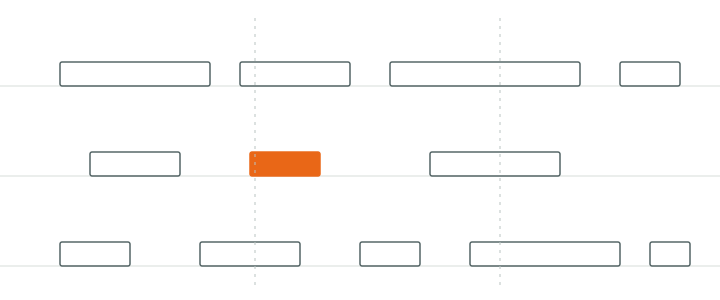
Where the lanes stop lining up is where the work stalls.
Our Customers
Our engagements work best with organizations between twenty and five hundred people, and most comfortably in the fifty to one hundred range. Below twenty, the process usually still fits in one or two heads and the investment is difficult to justify. Above five hundred, you likely have an internal operations function and different requirements.
We work across industries rather than within one. Understanding your business is not a prerequisite for understanding your business process, and coming from outside your sector tends to surface assumptions that people inside it have stopped noticing.
What we do require is a client who intends to do the work. Documented process changes nothing on its own, and no consultant can substitute for the follow-through.

Our Clients
- City of Richmond
- Technical Safety BC
- Lahlouh
- Plascon Plastics
- Harbourside Hospitality
- DAGLabs
- Baro
- Blue Door Communications
Two years after the engagement closed, Lahlouh told us the process mapping had been one of the most valuable exercises they had ever undertaken.
Lahlouh, print and supply chain services, San Francisco Bay Area
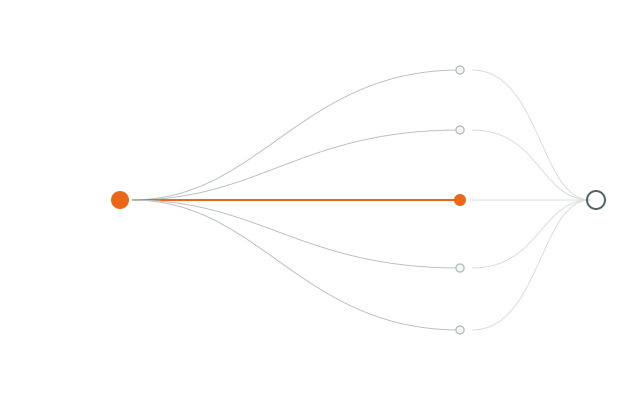
If you could optimize one process today, which one would it be?
That answer is usually the right place to start. Tell us what it is and we will tell you honestly whether we can help, and what addressing it would involve.