
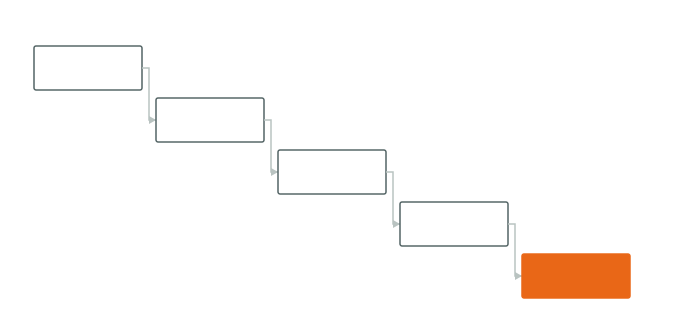
Five Stages of Process Improvement
Each stage produces something you can use before the next one begins, and each depends on the one before it. Clients occasionally arrive with the earlier stages already complete, in which case we begin where the work actually is.
Process Discovery and Mapping
We interview the people who perform the work and document what actually happens, step by step, including the parts that were never intended to happen. The result is a visual map that a room full of people can stand in front of and argue about productively.
This stage frequently produces its own surprises. It is common for a manager to sit in on an interview and discover that the process they believed was running has evolved into something quite different, and that the difference is where the cost lives.
- One-to-one sessions with the subject matter experts who execute the process, with their supervisor present
- Current-state maps showing workflow steps, decision logic, documents produced, applications used, and every handoff
- A documented inventory of workarounds, shadow spreadsheets and informal approvals
- Ownership gaps identified, so that every step without a clear owner is visible
Workshops and Gap Analysis
A facilitated session in which your team examines its own process laid out in front of them. Disagreement in this room is the point rather than a problem, because the disagreements identify precisely where the process is ambiguous.
Our role in these sessions is largely to record and structure what your people already know. The improvements that come out of a good workshop are almost always theirs.
- Facilitation in person or remotely, with in-person sessions producing consistently richer discussion
- Gaps ranked by cost and effort to address, rather than by who advocated most forcefully
- Target-state process agreed within the session, not circulated for comment afterwards
- A written record of what was decided and who owns each decision
Identifying Learning Opportunities
Before a word of documentation is written, we establish what each role genuinely needs to be able to do. This determines the scope, depth and structure of everything that follows, and skipping it is the reason so much corporate documentation manages to be simultaneously too long and insufficient.
- Role-by-role capability requirements drawn from the agreed target-state process
- A distinction between what people must know, what they must be able to look up, and what they never need to see
- Identification of where the current gap is knowledge, where it is skill, and where it is simply that nobody was told
- The specification that the documentation and training are then built against
Standard Operating Procedures
Procedures written to the specification the previous stage produced. Authoritative enough to settle a question, concise enough that someone under time pressure can find the answer without reading a chapter.
We have inherited plenty of eighteen-page procedures that were technically complete and practically useless. Length is not thoroughness. A procedure nobody opens documents nothing.
- Step-level procedures with inputs, outputs, owners and escalation paths
- Consistent structure and voice across every document, so that familiarity with one transfers to all
- Delivered in editable formats you own, whether that is Word, Markdown, or written directly into SharePoint, Confluence or your existing knowledge base
- A version and maintenance convention, so the second revision does not quietly contradict the first
Training Development and Delivery
Training built directly from the procedures, which keeps the two from drifting apart as they invariably do when different people produce them at different times. This is the stage that determines whether the previous four were worth commissioning.
- Role-based training materials derived from the procedures rather than written alongside them
- Quick-reference summaries and checklists for the tasks people perform under pressure
- A defined onboarding path for each role, so that new hires stop learning by observation alone
- Facilitated delivery to your teams, and a train-the-trainer session so the capability remains with you
Choose Your Own Adventure
Three ways to work together, depending on how much of the ground you want covered and how much of it you would rather own yourselves.
Assessment
Two to three weeks. Discovery, mapping, gap analysis and a written recommendation. It concludes with a clear account of what is wrong, what it is costing you, and what addressing it would require. Fixed fee.
Full engagement
Typically four to twelve weeks depending on scope. All five stages for one function or one family of processes, with deliverables released in batches throughout rather than held to the end. Fixed fee, milestone based.
Retained advisory
An agreed number of days each month to keep documentation current, map new processes as they emerge, and deliver training as you hire. Suited to organizations that want the function without adding the headcount.
Fees depend on the number of processes and people involved, so we quote after the first conversation rather than publishing a rate card that would be wrong for most of the organizations reading it.
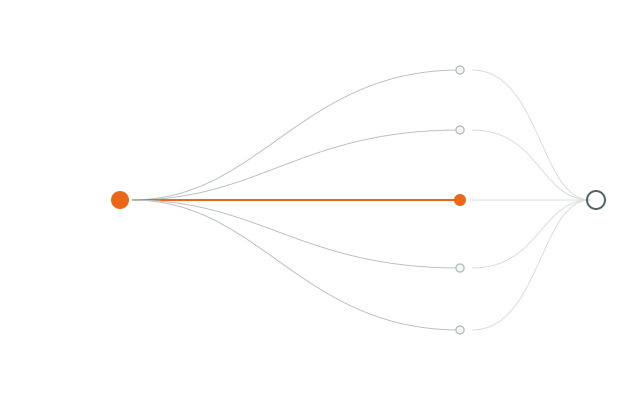
Different routes, same destination. Which one suits depends on where you are starting.
Other Services
Process work is where most of our engagements begin, and it is what this site is built to explain. It is not the whole of what we do. Over the past decade we have also worked with clients on financial and operational analysis, customer experience programmes, employee engagement, leadership development and business coaching.
Where a process engagement surfaces a problem that sits outside its boundaries, we would rather tell you so than pretend the map solves it. In many cases we can address it directly, drawing on specialists from our network as the work requires.
Let's Talk
Describe the situation and we will tell you whether it is the right kind of problem for us, and roughly what it would take to address.