

Process Mapping and Documentation
A structured engagement that catalogues every internal process, ranks them by business impact, and documents how the work is actually performed, rather than how management believes it is performed or how it was designed some years ago.

Undocumented process is a cost you are already carrying, whether or not it appears anywhere in your accounts.
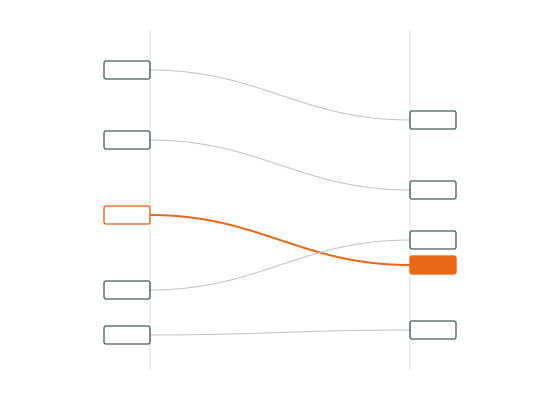
Handoffs are where undocumented work most often stalls.
Most companies reach a point at which growth requires a foundation of documented, repeatable process, and discover they do not have one. This is an entirely normal place to arrive. It stops being harmless at the moment when headcount, acquisition or turnover outpaces the number of people who remember how things are done.
The absence presents in predictable ways. Onboarding varies according to who is available to deliver it. Inefficiencies persist because no single person can see the whole of a flow. Institutional knowledge concentrates in a small number of individuals. Cross-training is agreed in principle and never scheduled.
The remedy is not a software purchase. It is a documented inventory of the work, a ranked plan determining which parts to address first, and maps produced from sessions with the people who actually perform the process.
What Success Looks Like
Identify and catalogue every process
A comprehensive inventory of internal processes across every department, organized by function, department and workflow sequence.
Establish a prioritization framework
A systematic basis for deciding what is addressed first, weighing revenue impact, operational efficiency, customer experience and onboarding requirements.
Produce visual process maps
Clear maps of how work actually flows, capturing decision points, handoffs, documents produced and the applications used at each step.
Deliver value before the project ends
Maps are released in batches throughout the engagement. Usable documentation reaches you within the first month rather than at final handover.
Build internal process awareness
The workshops themselves raise organizational understanding of how work is performed, and routinely surface inefficiencies that had been invisible to management.
Process Identification Workshop
Phase one · one to two weeks
A facilitated session, or series of sessions, building a comprehensive inventory of internal processes across the organization. This is the foundation of the engagement. It ensures nothing critical is overlooked and produces the roadmap for every mapping session that follows.
It runs as a single full day or as several half-days, depending on the availability of department heads. Remote participation is supported, though in-person sessions produce consistently richer discussion.
In the room
- All department heads and functional leaders
- Key stakeholders who understand cross-functional workflows
- Executive sponsor, on periodic check-ins
What happens
- Process discovery. Each department head walks through how work begins, how it flows and how it concludes within their area of responsibility.
- Cross-functional mapping. Identifying the processes that span departments or depend on a handoff between teams.
- Sub-process identification. Surfacing the activities people perform daily without recognizing them as formal processes at all.
- Naming and categorization. Establishing a single consistent naming convention and structure, so that the catalogue remains usable as it grows.
Deliverable
Process Index. A catalogue of every identified process, organized by department and function with a preliminary numbering system. It becomes the master reference for the engagement, and the first clear view of how much documentation is actually required.
Prioritization and Planning
Phase two · one to two weeks
Not all processes carry equal weight. Some affect revenue directly. Some determine whether a customer renews. Some are the difference between a new hire becoming productive in two weeks or in two months. This phase establishes the sequence, so that effort is directed where it returns most.
Prioritization criteria
| Factor | The question it answers |
|---|---|
| Revenue impact | Does this process directly affect sales, billing, or revenue recognition? |
| Operational efficiency | Is time being lost to unclear or inconsistent execution? |
| Customer success | Does this process touch the customer experience or service delivery? |
| Onboarding criticality | Is this process essential for training a new employee? |
| Risk exposure | Would failure here create significant operational or compliance risk? |
| Frequency | How often is it executed? Daily processes warrant earlier attention. |
Deliverables
- Prioritized process list. The Process Index reordered by priority, with the rationale for the sequencing set out in writing.
- Mapping session schedule. A calendar of subject matter expert sessions built around priority order and genuine availability.
- Stakeholder alignment. Documented agreement on priorities from leadership, so that the sequence is not reopened for debate in week six.
Process Mapping Sessions
Phase three · eight to twenty weeks
The core of the engagement. Each session brings together the subject matter expert who performs the work, their supervisor, and a facilitator, and runs sixty to ninety minutes per process depending on complexity.
The subject matter expert walks through the process step by step while the facilitator captures the workflow, the decision points, the documents and the applications. The supervisor attends because the distance between the two accounts is frequently the most valuable finding of the session.
What gets captured
- Sequential workflow steps, start to finish
- Decision points and branching logic
- Documents created, used, or referenced
- Software applications and systems involved
- Handoffs between individuals and departments
- Timing and triggers, meaning what initiates the process and what signals its completion
The discovery is half the value
When a subject matter expert walks through their actual work, managers regularly discover the process has evolved in ways nobody recorded. Workarounds, informal procedures and undocumented approval steps become visible. That transparency produces improvement opportunities before a single map has been finalized.
Batched delivery
Maps are reviewed, finalized and delivered in batches as they are completed, rather than held until the end of the engagement. After the first several sessions you have usable maps in hand for training, onboarding and everyday reference.
Process Map Example
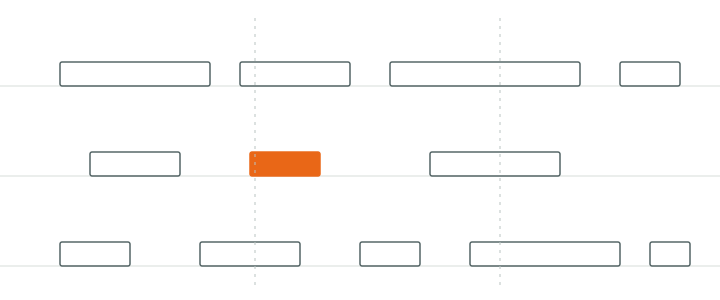
Every map uses the same visual language: three horizontal lanes separating the workflow steps from the documents they produce and the applications they use. An executive can read the top lane alone. A new hire can follow all three. The convention is illustrated below using a simplified order-to-invoice flow.
Deliverables
| Phase | Duration | Deliverable | What it is |
|---|---|---|---|
| 01 | 1-2 weeks | Process Index | Catalog of all processes by department, with a numbering system |
| 02 | 1-2 weeks | Prioritized list | Processes ranked by business impact, with written rationale |
| 02 | — | Session schedule | Calendar of mapping sessions aligned to priority and availability |
| 03 | 8-20 weeks | Process maps | Swimlane diagrams covering steps, documents, and applications |
A focused engagement completes in approximately three months. Phase 03 is the variable, and its length depends on how many processes emerged from Phase 01 and how available your subject matter experts are. Sessions can be run in intensive blocks or at a measured pace that keeps disruption to daily operations to a minimum.
The Real Benefit
Immediately
- Faster onboarding. New employees consult documented process rather than depending on whoever has time to explain it.
- Training material with a foundation. The maps underpin it, and they are consistent across every role.
- Cross-training becomes practical. People can learn adjacent roles and provide genuine coverage.
- Operational visibility. Leadership can see how work moves through the organization as a whole.
Over time
- A foundation for growth. Documented process replicates as you scale. Undocumented process does not.
- Identifiable bottlenecks. Visual maps make inefficiency legible, and therefore something that can be discussed and addressed.
- Reduced key-person risk. Critical knowledge no longer resides solely with a handful of individuals.
- A baseline for improvement. Process improvement cannot be measured without a documented starting point.
- A route to full documentation. Maps are the substrate on which standard operating procedures and training are subsequently built.
What to Expect
- Workshop scheduling coordinated around department head availability.
- Access to the individuals who actually perform the processes being mapped. This is not negotiable, because mapping conducted without them produces a description of intent rather than a record of practice.
- Review turnaround on batched maps, so that each batch can be finalized before the next is delivered.
- Travel and expenses, where on-site sessions are required, are charged in addition to the engagement fee.
How to Start
Phase 01 stands on its own. An organization that commissions nothing beyond the identification workshop still leaves it knowing exactly how many processes it has and which of them are load-bearing.